Views: 0 Author: Site Editor Publish Time: 2026-09-06 Origin: Site
Choosing between organic and compound fertilizer manufacturing shapes your entire business model. It dictates your initial capital expenditure. It also defines your facility blueprint and long-term operational costs. Plant managers often face a difficult crossroads here.
Both production lines ultimately yield granulated fertilizers. However, their raw material handling approaches differ immensely. You will face fundamentally distinct processing times and compliance requirements. Organic methods rely on slow biological breakdowns. Compound methods demand rapid chemical precision. Finding the most efficient path requires careful analysis of these variables.
We designed this guide for plant managers and investors. You will find an evidence-based comparison of both production processes below. We cover specific equipment requirements. We also examine environmental constraints and production scalability risks. Our goal is simple. We want you to confidently shortlist the right manufacturing solution. You can then align your factory floor directly to your target market needs.
The Organic Fertilizer Production Process is biologically driven, requiring significant footprint for fermentation and specialized odor-control systems.
The Compound Fertilizer Production Process is chemically and mechanically driven, prioritizing precise batching, high-throughput granulation, and corrosion-resistant machinery.
Selecting the right fertilizer equipment depends heavily on raw material consistency; organic inputs require robust pre-treatment, while compound inputs require precise formulation.
Hybrid configurations exist but require custom engineering to handle the moisture and structural differences between organic and inorganic materials.
Understanding the fundamental mechanisms driving each line helps you anticipate operational bottlenecks. Every stage dictates specific requirements for moisture control, timing, and raw material handling.
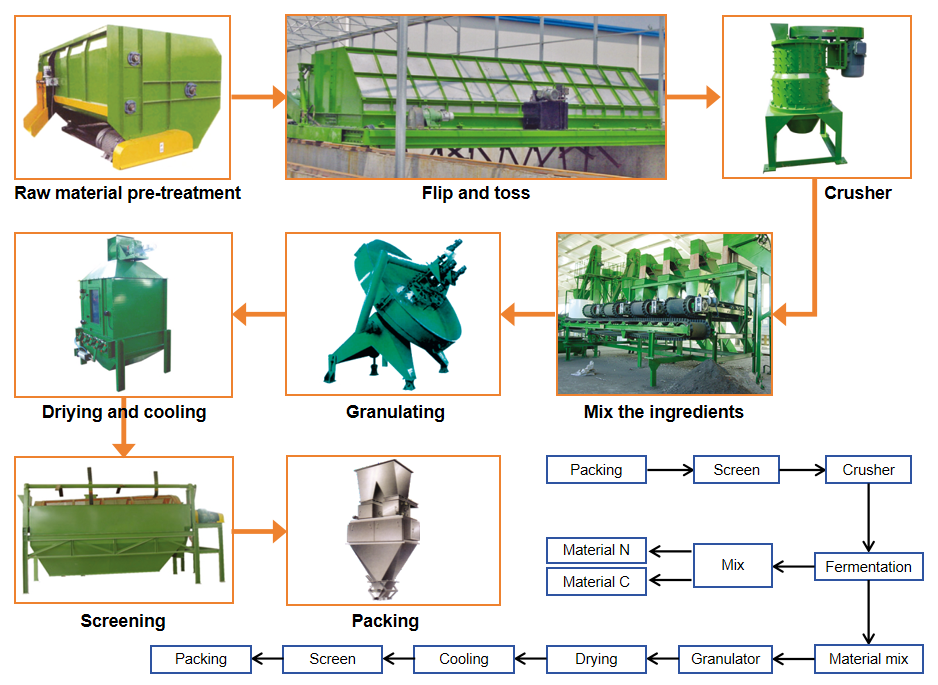
The Organic Fertilizer Production Process relies heavily on biological breakdown. It transforms raw agricultural waste or manure into stable nutrients. Mechanical shaping only occurs after this biological phase finishes.
The key stages follow a strict chronological order. You begin by dewatering raw materials. Next comes fermentation and composting. You then crush the composted matter. Granulation follows. Finally, you dry, cool, screen, and package the final granules.
This process presents a harsh reality for facility operators. You are highly dependent on controlling moisture and temperature. The fermentation phase typically lasts 7 to 21 days. Granulation cannot even begin until this biological stabilization concludes. Common mistakes include rushing the fermentation phase. This oversight leads to sticky raw materials. Sticky materials frequently clog granulators and ruin batch consistency.
The Compound Fertilizer Production Process operates on entirely different principles. It relies on mechanical blending and chemical binding. You combine inorganic salts and minerals to create precise nutrient profiles.
The key stages prioritize speed and continuous flow. You start utilizing dynamic batching systems. Crushing and mixing happen simultaneously. Granulation follows immediately. You then dry and cool the granules. Coating is applied next. Finally, you screen and package the product.
This workflow demands immediate, continuous processing. You must maintain high precision in NPK ratios. Strict moisture control during the drying phase prevents caking. A major best practice involves monitoring dryer exit temperatures closely. Fluctuating temperatures often cause granules to fracture. They might also fuse together into unmanageable clumps in the cooling drum.
You can optimize your capital layout by understanding machine overlap. Some components serve both production types perfectly. Other machines remain rigidly specialized for specific raw materials. Choosing the right Fertilizer Equipment ensures long-term operational stability.
Several utility machines cross over between both processes seamlessly.
Belt conveyors and bucket elevators transport materials between stations effectively.
Rotary dryers and coolers handle moisture removal. They operate at vastly different temperature thresholds depending on the product.
Rotary screening machines classify granule sizes accurately.
Automated bagging scales ensure precise final packaging weights.
Organic raw materials are fibrous, sticky, and moisture-rich. Your machinery must handle these challenging physical properties daily.
Compost turners serve as the heartbeat of the organic pre-treatment phase. You can choose windrow, crawler, or trough types. They are critical for oxygenating organic matter. Proper oxygenation speeds up microbial breakdown.
Crushers need special configurations. They must process high-moisture, semi-wet materials. Standard crushers will clog immediately. You need specialized semi-wet material crushers to avoid constant downtime.
Granulators also require careful selection. Disc pan granulators perform well here. Wet-type stirring granulators are equally preferred. They leverage organic matter's unique binding properties efficiently.
Compound materials are dry, abrasive, and often highly corrosive. They require heavy-duty engineering.
Batching systems represent your first critical investment. You require high-precision static or dynamic weighing silos. Exact chemical formulations guarantee your NPK label accuracy.
Granulators must withstand intense friction. Rotary drum granulators excel in this environment. Double roller extrusion granulators also handle chemical reactions beautifully. They easily manage higher density materials.
Coating machines become mandatory for inorganic lines. They apply anti-caking agents to the finished granules. Without proper coating, inorganic fertilizers absorb ambient humidity. They will quickly harden into solid blocks during storage.
Equipment Type | Organic Process Role | Compound Process Role | Primary Engineering Focus |
|---|---|---|---|
Pre-treatment | Compost Turners (Aeration) | Dynamic Batching (Precision) | Moisture handling vs. Weighing accuracy |
Granulation | Disc Pan / Wet-stirring | Rotary Drum / Extrusion | Gentle shaping vs. High-pressure binding |
Finishing | Biological coating (optional) | Anti-caking coating (mandatory) | Preserving microbes vs. Blocking humidity |
Your geographical location and available land directly influence your choice. Production lines require vastly different spatial planning. They also trigger entirely different environmental regulations.
Space becomes your primary constraint. An organic line requires a significantly larger footprint. Expect to need 30% to 50% more floor space than a comparable compound facility. The fermentation trenches consume most of this area.
Compliance risks run high in this sector. Local authorities will heavily scrutinize odor emissions. Leachate, or harmful wastewater runoff, also draws strict regulatory attention. Bio-filters are often mandatory. Negative pressure systems must frequently run inside the fermentation halls. A common mistake involves underestimating ventilation requirements. Poor ventilation leads to rapid structural corrosion and severe neighborhood complaints.
Space planning offers more flexibility here. The layout remains much more compact. Vertical integration is highly possible. You can stack batching silos above mixing platforms to save ground space.
Compliance risks shift toward chemical hazards. You must focus on intense dust mitigation. Chemical spill containment protocols are strictly enforced. Handling corrosive fumes becomes a daily priority. This is especially true if you utilize ammoniation processes.
Material integrity demands specific industrial upgrades. Your machinery requires higher grades of anti-corrosion stainless steel. Using 316L stainless steel prevents rapid degradation from inorganic salts. Skimping on steel quality guarantees catastrophic equipment failure within the first three years of operation.
Financial planning requires looking past the initial machine price tags. You must evaluate raw material costs, hourly output rates, and long-term expansion capabilities.
Organic production presents an interesting financial paradox. You enjoy a lower upfront equipment cost for the actual granulation phase. However, you face exceptionally high costs elsewhere. Land acquisition is expensive. Building expansive concrete fermentation infrastructure drains initial capital quickly.
Compound production flips this financial model. You face much higher initial machinery costs. Precision batching electronics are expensive. Heavy-duty granulators require massive steel investments. Anti-corrosive materials inflate the baseline machinery quotes considerably. However, you save substantially on required land size.
Organic operations benefit from cheaper raw materials. You often utilize agricultural waste or municipal sludge. These inputs cost very little. Unfortunately, your hourly throughput remains comparatively low. Scaling this operation presents massive hurdles. Doubling output means you need exponentially more fermentation space.
Compound operations rely on expensive commodity raw materials. You must purchase Urea, MAP, and DAP at global market rates. Despite high input costs, the system is highly scalable. A single rotary drum line can push 10 to 30 tons per hour consistently. You can run these lines 24 hours a day. Scaling simply involves upgrading granulator sizes or adding a parallel drum.
Selecting the optimal path requires a rigid assessment of your local resources. You should not guess. Use the following framework to finalize your strategy.
Evaluate Your Raw Material Supply Chain: Can you secure a localized, cheap supply of manure or biomass? If yes, lean toward an organic setup. Do you have access to bulk chemical commodities via port or rail? If yes, lean toward a compound setup.
Assess Target Market Demand: Identify who will buy your final product. High-margin, niche agriculture justifies the slower organic process. Vineyards and certified organic farms pay premium prices. Conversely, broadacre farming demands high volume. Crops like corn, wheat, and soybeans require the immediate nutrient release of compound fertilizers.
Request Layout Blueprints: Ask manufacturers for specific footprint diagrams. Verify that your current land can house the required fermentation zones or vertical silos.
Verify Equipment Guarantees: Demand written corrosion guarantees. Ensure the steel grades match your chemical inputs.
Calculate Exact Power Consumption: Request the kW/h rating per ton of output from shortlisted manufacturers. This metric reveals the true daily operational burden of the machinery.
There is no universally superior production line. The right choice bridges your available raw materials directly with your target market's agronomic needs. Balancing these two factors ensures long-term profitability.
We recommend following these actionable steps as you move forward:
Do not purchase machinery a la carte. Work with a manufacturer who can engineer a full, synchronized line.
Ensure your vendor maps out transition points. This prevents bottlenecking between the mixing, granulating, and drying phases.
Secure local environmental permits before breaking ground. Address odor or dust control in your earliest budgeting phases.
Design your facility layout with a 20% expansion buffer. This allows you to add secondary granulators later without tearing down walls.
A: Partially. While conveyors, dryers, and packagers can be shared, the core granulators and pre-treatment machines are highly specialized. Producing both usually requires a "Bio-organic Compound" hybrid line. This demands custom engineering to handle vastly different moisture levels.
A: Compound fertilizer lines typically offer a faster ROI. They provide high-volume throughput and continuous processing. You can generate revenue faster, provided you secure stable pricing for your chemical raw materials.
A: Site preparation and fermentation time represent major hidden costs. Buyers frequently underestimate the extensive concrete work required for fermentation trenches. They also overlook the heavy labor and fuel costs necessary for turning compost continuously over 14 to 21 days.